
SDF: Software-Defined Factory Testbed for Hybrid Subtractive-Additive Remanufacturing Processes
Every worn blade is different, and no fixed CNC program can repair it. This digital twin-driven, vendor-neutral cell decides each cut and deposit in the loop, turning a skill held by a shrinking pool of experts into a process that can be repeated and moved between sites.
Turbine blades are among the most demanding parts in mechanical engineering: high-value, hard to cut, and worn differently every time. On the MRO line behind this testbed, repair is entirely manual: hand-grinding, weld build-up and re-grinding, one part at a time, by a shrinking pool of expert machinists, with no digital record and no process that can move to another site. As those experts retire, their know-how goes with them. The Software-Defined Factory (SDF) Testbed sets out to show that a process digital twin can decide fast enough, in the loop, to repair these parts without operator intervention.
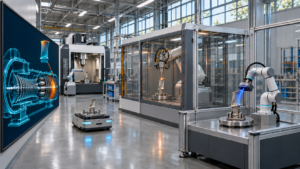
A digital twin can plan a machining-only job in advance. A hybrid cut-deposit-recut repair cannot be planned that way: the workpiece changes shape at every step, and no two worn parts are alike. The team has found no precedent for a digital twin that closes the loop on a target like this. So the cell runs on a model-based, real-time decision engine instead of a fixed program. It integrates 5-axis machining, robot-mounted directed-energy-deposition (DED) metal additive, 3D-scanning metrology and robotic handling on a Software-Defined Factory platform held by the Korea Institute of Machinery and Materials (KIMM). Three layers of digital twins (factory, machine and process) connect through neutral standards: Asset Administration Shell (AAS) asset models and OPC UA companion specifications.
Phase 1, the DTC testbed, delivers a simulation-led minimum viable product, validated against measured wear and repair data from an anonymized power-generation blade MRO line under a data-sharing agreement. A follow-on phase takes the cell to a physical repair line. Because the cell is built on AAS and OPC UA, the same autonomous process can transfer across production lines and equipment vendors and be delivered as a remote, serviceable operation. The resulting architecture forms the seed of an SDF-based autonomous factory operating system aimed at small and medium-sized enterprises and overseas sites in the U.S., Europe and ASEAN.
The SDF Testbed aims to contribute to industry advancement in the following ways:
- A Twin for a Workpiece That Never Stays the Same: Conventional digital twins mirror machine control. This one closes the loop on a part whose shape changes at every cut, deposit and re-cut, moving digital twins toward autonomous decision-making for processes no fixed CNC program can handle.
- AAS–OPC UA Interoperability Across Suppliers: KIMM will close the AAS-to-OPC UA mapping gap for machining and hybrid-process assets and contribute the resulting AAS submodels and companion-specification extensions to IDTA, the OPC Foundation and Digital Twin Consortium, so that cells from different suppliers can interoperate on OEM production lines.
- A Reference for Autonomous Repair: Validated first in simulation within the DTC testbed and then, in a follow-on phase, on a physical repair line, the testbed establishes a reference for autonomous, low-manning repair of high-value components, backed by quantified targets for repair success rate, geometric accuracy and deposition integrity.
- A Blueprint Tested for Portability: Vendor neutrality holds only if the process runs unmodified elsewhere, so the testbed will test it across equipment vendors. The three-layer architecture of factory, machine and process gives the cutting and metal additive industries a standards-anchored blueprint for turning measurement, deposition and machining assets into software-defined resources.
- Expertise That Outlives the Expert: The aging of the expert repair workforce is a global competitiveness threat. By capturing manual, skill-bound repair as a digital, AI-driven process, the testbed shows how critical know-how can be retained and transferred across sites.
- Factory Operations Within Reach: A factory operating system derived from the testbed targets small and medium-sized enterprises and overseas sites, lowering the cost barrier to digital twin-based factory operations.
Lead Developer

Co-Developer

Contributing Technology Providers
SMEC
AM Solutions