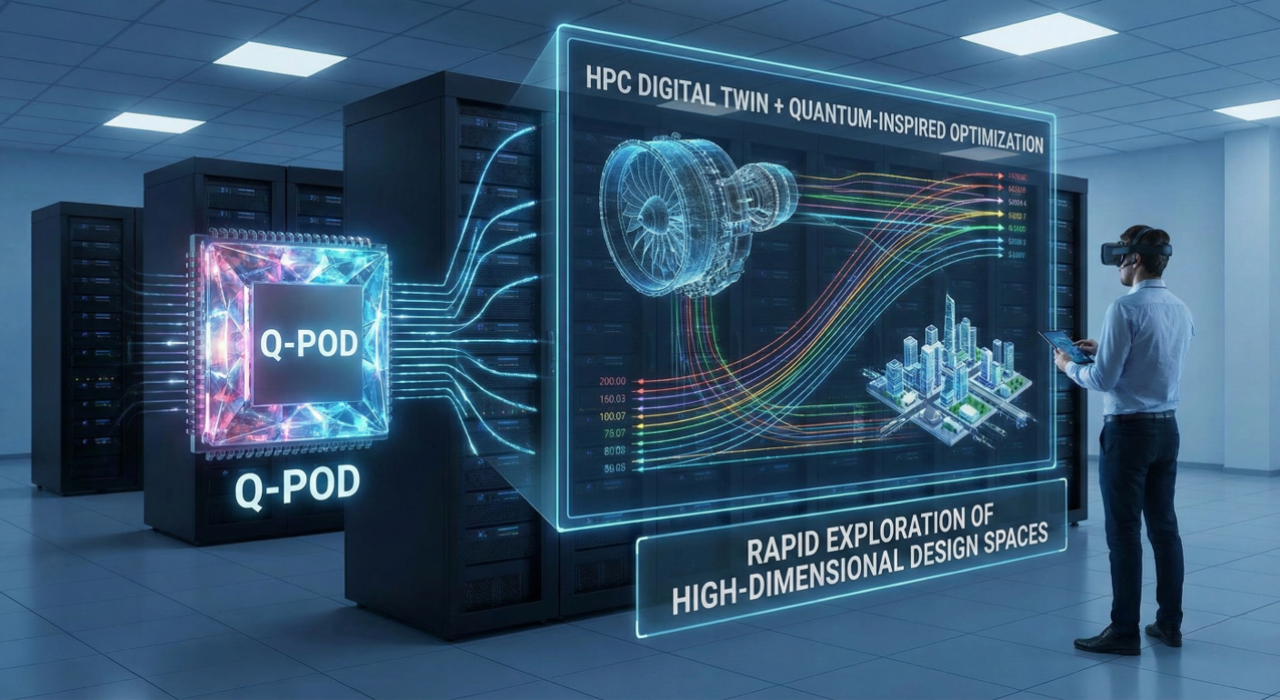
Quantum-inspired optimization integrated into HPC digital twin environments for aerospace, defense, and space applications, achieving 10x faster computation and expanded design exploration
The Q-POD testbed proposes to integrate quantum-inspired optimization into HPC digital twin environments, enabling rapid exploration of high-dimensional design spaces and solving system-level problems previously beyond classical limits. Engineers depend on digital twins to simulate and analyze complex systems, but traditional optimization approaches often require conservative design margins, increasing cost and reducing performance. This testbed aims to rigorously evaluate the integration of advanced optimization with multi-disciplinary models and real-time data.
The proposed experimental approach will benchmark quantum-inspired optimization solvers against state-of-the-art classical optimization methods using representative digital twin models. The testbed seeks to execute system-level multi-disciplinary optimization (MDO) workflows, integrating quantum-inspired solvers within existing HPC environments, and evaluate integration processes, runtime performance, and solution quality across multiple engineering use cases in aerospace, defense, and space systems.
Target metrics include scalability from 100 to 10,000+ design variables, runtime reduction (e.g., from 5 hours to 30 minutes), solution quality improvement of at least 10% over baseline methods, reduction in required prototyping iterations, and quantified cost and efficiency improvements in design and manufacturing processes. The testbed aims to boost performance, safety, and efficiency in engineering workflows while transitioning toward quantum-ready digital engineering.
The Q-POD testbed aims to contribute to industry advancement in the following ways:
Repeatable Optimization Workflow: Proposing to contribute a repeatable workflow for scaling system-level optimization in digital twin environments.
Quantum-Ready Integration Blueprint: Aiming to provide a blueprint for integrating quantum-ready optimization into existing engineering pipelines.
Interoperability Guidelines: Seeking to modernize and inform emerging Digital Twin interoperability and Model-Based Optimization integration guidelines.
Best Practices Development: Proposing to support development of best practices for high-dimensional, multi-disciplinary optimization in critical industries.
Knowledge Transfer: Aiming to enable knowledge transfer to standards bodies (including AICPA SOC, ISO 9001, ISO 27001, ISO 27017) and the broader digital engineering community.
- Industry Sector Impact: Seeking to advance the industry's ability to shorten development cycles, explore broader design spaces, and reduce program costs for aerospace, defense, and space organizations.
Member, Lead Developer