
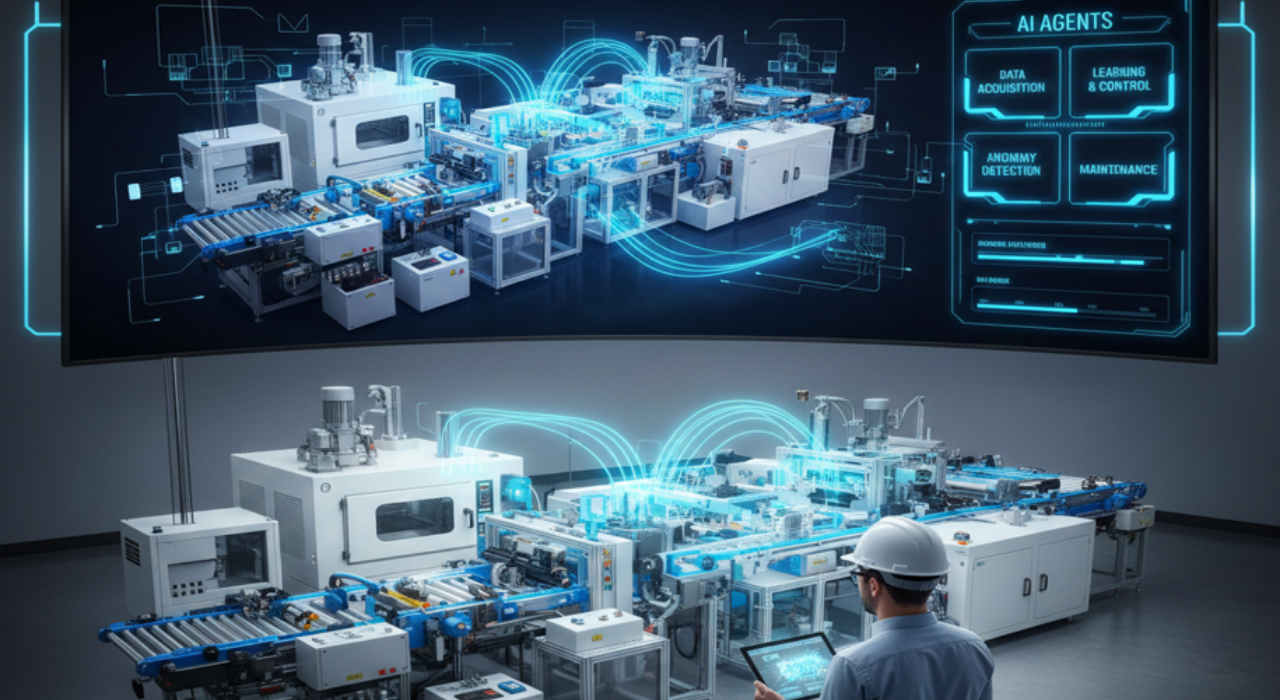
Multi-agent digital twin architecture enabling autonomous control and collaborative optimization for advanced battery electrode manufacturing with transfer learning capabilities
The MANDATE-R2R testbed validates an approach to autonomous manufacturing control using a Multi-Agent Digital Twin (MADT) system implemented on roll-to-roll electrode-coating equipment for secondary battery production. This innovative architecture integrates digital twins, a physical twin and multiple AI Agents that collaboratively perform data acquisition, learning, control, anomaly detection, and maintenance operations without human intervention, achieving real-time precision equal to or superior to human expert-based control.
Implementation leverages transfer learning technology, enabling new digital twin models to achieve full training with fewer than 50 data samples—a dramatic reduction from traditional approaches requiring thousands of samples. The testbed operates in a comprehensive environment featuring R2R electrode coating equipment, digital twin computation servers, edge computers, and AI Agent infrastructure connected through OPC-UA protocol communication. Validation methods include real-time monitoring, comparative analysis against human expert benchmarks, and statistical evaluation of control and anomaly detection performance across varying production scenarios.
Expected outcomes position this testbed to transform battery manufacturing by reducing defect rates, enhancing productivity, and lowering maintenance costs while enabling unmanned factory operation. The multi-agent architecture proves scalable and reusable for other continuous production environments including display film and fuel cell manufacturing, establishing a foundation for distributed AI Agents that autonomously diagnose and optimize process conditions across global manufacturing networks.
The MANDATE-R2R testbed aims to contribute to industry advancement in the following ways:
Global Expansion and Validation: Verified in Korea and planning for global expansion, the testbed proposes to demonstrate distributed AI Agents autonomously diagnosing and optimizing process conditions in remote manufacturing environments.
Manufacturing Performance Improvements: Aiming to reduce defect rates, enhance productivity, lower maintenance costs, and enable unmanned factory operation.
Reusable Multi-Agent Architecture: The multi-agent architecture is designed to be reusable for other continuous production lines (e.g., display film, fuel cell manufacturing).
Standards and Best Practices: Seeking to contribute to the formation of global standards, best practices, and knowledge transfer for AI-driven manufacturing autonomy, with stakeholder engagement from Digital Twin Consortium, IEC, and ISO.
Industry Sector Impact: Proposing to advance global best practices in AI-enabled manufacturing autonomy for battery manufacturers, equipment builders, material suppliers, and automation solution providers.
Member, Lead Developer

Co-Developer

Contributing Technology Providers
- PNT Co., Ltd