
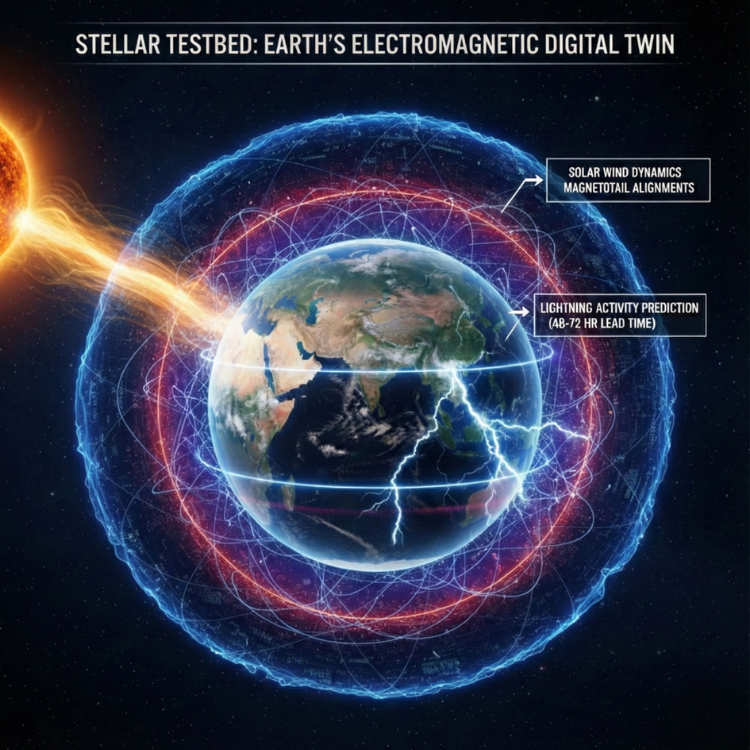
Advanced digital twin integrating solar-terrestrial electromagnetic coupling for operational lightning forecasting with 48-72 hour lead time and monsoon prediction capability
STELLAR addresses a critical challenge facing India: a 57% increase in lightning incidents between 2019-2024, resulting in approximately 1,800-2,000 annual fatalities. This comprehensive digital twin of Earth's magnetosphere-ionosphere-atmosphere electromagnetic coupling system validates the groundbreaking Stellar Transformer concept, demonstrating that lightning activity can be predicted based on solar wind dynamics and magnetotail alignments with specific tectonic features. By establishing operational forecasting capabilities with 48-72 hour lead time, STELLAR transforms lightning hazard management from reactive response to proactive prevention.
The testbed integrates real-time space weather data from solar wind monitors, geomagnetic observatories, and atmospheric sensors deployed across the Indian subcontinent into a unified digital twin operating at one-hour temporal resolution. Advanced magnetohydrodynamic models simulate magnetotail dynamics while hybrid physics-machine learning algorithms correlate solar-terrestrial electromagnetic coupling with atmospheric lightning generation. The system validates that peak lightning activity correlates with magnetotail magnetic moment alignment to specific tectonic features—the Mid-Pacific blown circuit, Banda Sea Mantle Vortex, and Central Indian Ridge—with correlation coefficients exceeding 0.65 within ±3 hours of alignment events.
Expected outcomes include lightning nowcasting with probability of detection exceeding 0.75 and false alarm rates below 0.30, monsoon onset predictions 2-4 weeks in advance with greater than 70% accuracy, and quantified space-weather-to-lightning coupling pathways. The testbed targets a 10-20% reduction in annual lightning fatalities through enhanced early warning dissemination to disaster management agencies, agricultural communities, and aviation operations. STELLAR establishes India as a global leader in space-weather-to-ground coupling science while advancing best practices for multi-domain Earth system modeling.
The STELLAR testbed aims to contribute to industry advancement in the following ways:
Multi-Domain Digital Twin Integration: Establishing best practices for Earth system digital twins that seamlessly integrate space weather observations, geophysical monitoring, and meteorological data across five orders of spatial and temporal magnitude.
Hybrid Physics-ML Modeling Standards: Validating hybrid modeling patterns that combine first-principles magnetohydrodynamic physics with data-driven deep learning architectures.
Space Weather Integration Guidelines: Contributing to World Meteorological Organization Lightning Detection Guidelines by incorporating geomagnetic indices and solar wind parameters as operational forecast inputs.
Stellar Transformer Theory Validation: Providing the first systematic validation of the Stellar Transformer hypothesis linking planetary electromagnetic circuits to atmospheric lightning generation via magnetotail-tectonic alignments.
Operational Forecasting Frameworks: Demonstrating end-to-end workflows for transitioning space physics research into operational disaster management applications with documented skill metrics, uncertainty quantification protocols, and multi-agency coordination procedures.
- Cross-Agency Collaboration Models: Documenting successful coordination frameworks between space agencies (ISRO), meteorological services (IMD), research institutions (IIG, IITM Pune), and engineering colleges for deploying distributed sensor networks, sharing restricted datasets, and delivering operational forecasts.
Lead Developer
Contributing Technology Providers
- College of Engineering Trivandrum